New Open Source SPFx Project: SharePoint Site Governance Dashboard
Billy Peralta
April 17, 2026 · 10 min read

TL;DR
I just launched a new open source SharePoint Framework project: SharePoint Site Governance Dashboard. It is a practical dashboard solution designed to help visualize site governance health across ownership, permissions, external sharing, stale content, lifecycle activity, storage, and compliance signals. It is built as a modern SPFx solution using React, TypeScript, Fluent UI, and the current production-ready SPFx baseline, while aligning with the newest SPFx release wave and where the platform is heading next.
Table of Contents
- Why I Built This Project
- Why This Is a Strong Fit for Modern SPFx
- What the Dashboard Does
- The Governance Areas It Covers
- Project Screenshots
- How the Solution Is Structured
- Why This Matters for Real SharePoint Environments
- Who This Project Is For
- How to Try It
- What I Want to Add Next
- GitHub Repository
- FAQ
- Final Thoughts
Introduction
I always like projects that sit between technical implementation and real business value. That is exactly where this one fits.
I recently released a new open source project on GitHub called SharePoint Site Governance Dashboard. It is a SharePoint Framework solution that turns governance signals into something far easier to review: a clean, business-friendly dashboard experience that highlights governance score, problem areas, alerts, and recommended actions.
Instead of treating governance like a spreadsheet exercise or a disconnected admin process, this project shows what it can look like when governance is surfaced directly through a modern SharePoint experience.
1. Why I Built This Project
SharePoint environments grow quickly.
As organizations add more team sites, communication sites, document libraries, integrations, and external sharing scenarios, governance often becomes fragmented. Ownership is not always clear. Permissions become more complex. Content gets stale. Sites stay active longer than they should. Important metadata and lifecycle signals are easy to miss.
That creates a gap between what administrators need to monitor and what site owners can actually understand.
I built this project to demonstrate a more practical approach: bring governance visibility into a dashboard that is simple enough for stakeholders to review, but structured enough for technical teams to extend.
This is not just a UI exercise. It is meant to reflect a real Microsoft 365 problem in a way that feels believable for enterprise use.
2. Why This Is a Strong Fit for Modern SPFx
One reason I wanted to build this as an SPFx project is simple: SPFx remains the right extensibility model for modern SharePoint solutions.
For developers and organizations working in SharePoint Online, SPFx is still the most natural way to deliver custom web parts and Microsoft 365 experiences that live close to the platform. That makes it a strong foundation for governance-related solutions, especially when the goal is to surface operational insight where users already work.
This project is currently built on SPFx 1.22.2, which is a solid production-ready baseline for modern development. At the same time, I wanted this launch to align with the newest SPFx release wave, where Microsoft is actively investing in tooling modernization, better list extensibility, open-sourced templates, and the emerging SPFx CLI model.
That matters because I did not want this to feel like a legacy sample. I wanted it to feel like a project that belongs in the current direction of the SharePoint Framework ecosystem.
3. What the Dashboard Does
At its core, the SharePoint Site Governance Dashboard provides a consolidated view of site health and governance quality.
The current version includes:
-
Overall Governance Score A weighted score from 0 to 100 that gives a quick snapshot of site governance health.
-
Domain Health Breakdown Individual scoring across multiple governance areas so problem zones are easier to identify.
-
Interactive Score Visualization A more engaging visual layer using a donut-style score presentation and trend indicators.
-
Governance Alerts Prioritized findings to help separate critical issues from lower-priority observations.
-
Actionable Recommendations Guidance tied to the assessment results so the dashboard is not just reporting problems, but also suggesting what to review next.
That combination is what makes the project useful as a portfolio piece. It demonstrates both front-end implementation and solution thinking.
4. The Governance Areas It Covers
The dashboard evaluates governance health across seven domains:
-
Ownership Does the site have valid, accountable ownership?
-
Permissions Are permissions becoming too complex or drifting away from inheritance?
-
External Sharing Is the sharing posture aligned with the expected risk level?
-
Content Freshness Is a meaningful percentage of the site content stale?
-
Activity & Lifecycle Has the site been meaningfully updated recently, or is it drifting into low-value territory?
-
Storage Is the site consuming quota in a way that deserves attention?
-
Compliance Signals Is governance-related metadata complete enough to support policy and review processes?
I like this structure because it mirrors how governance conversations happen in real organizations. Rarely is the issue just one thing. It is usually a combination of ownership, permissions, stale content, lifecycle ambiguity, and risk exposure.
5. Project Screenshots
One thing I wanted this project to show clearly is contrast. A governance dashboard should make it obvious when a site is healthy and when it needs attention.
Below are two screenshots from the project that help tell that story.
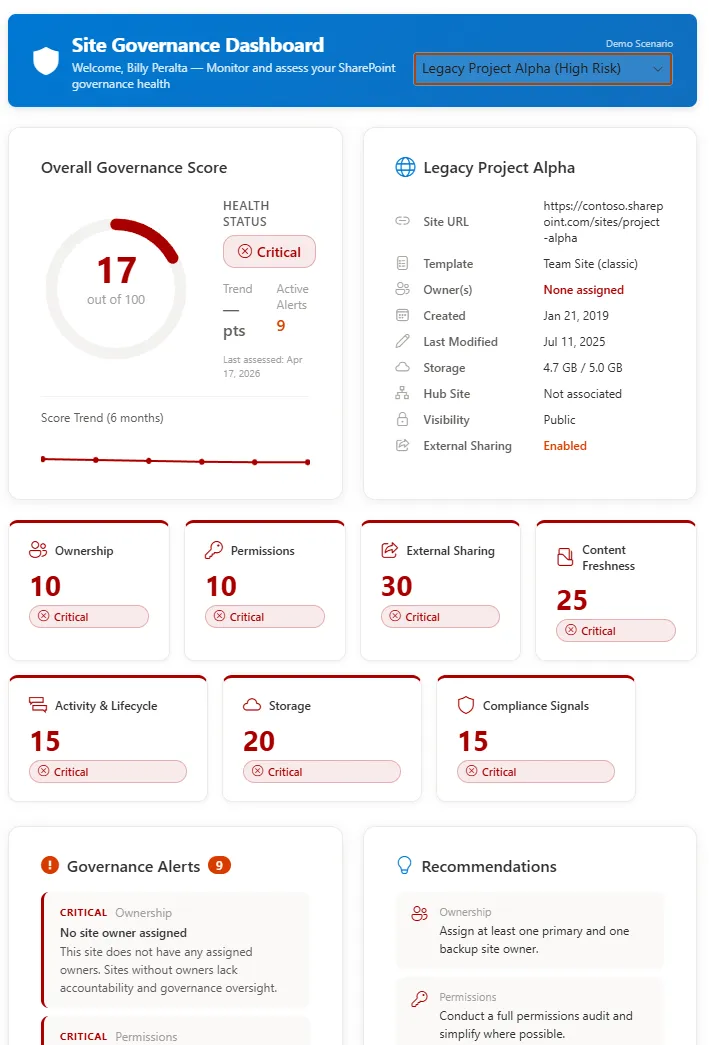
High-risk site scenario
This view shows a site with multiple governance issues: missing ownership, risky permissions, external sharing exposure, stale content, lifecycle concerns, and storage pressure. It is the kind of scenario where a dashboard needs to do more than display numbers. It should direct attention quickly.
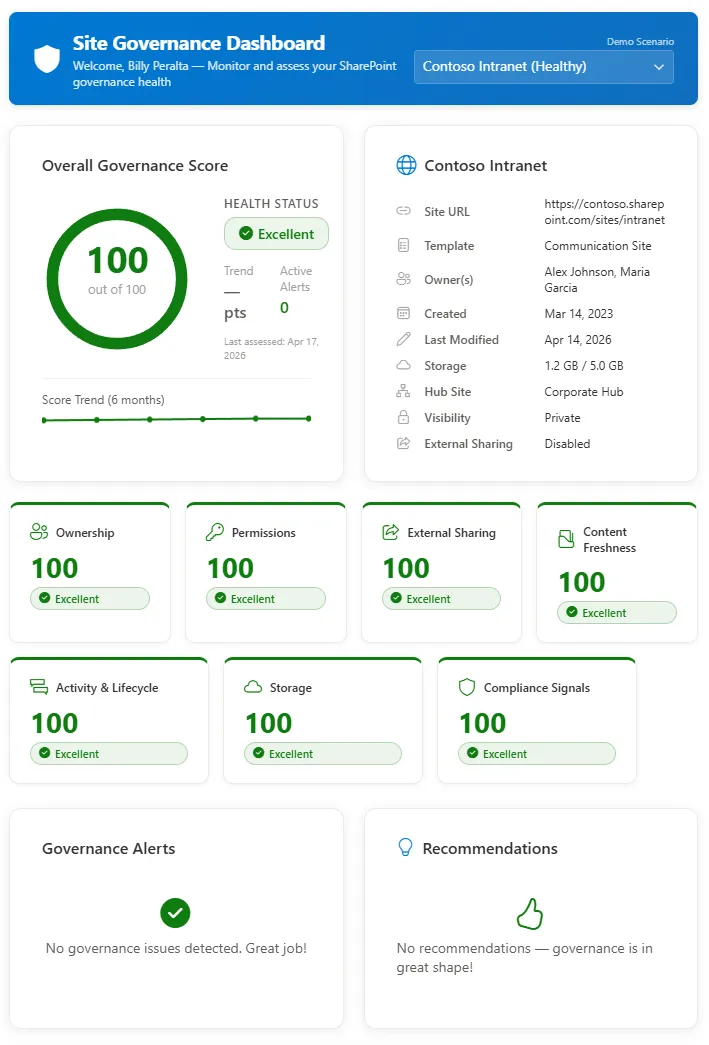
Healthy site scenario
This version shows the opposite case: strong ownership, controlled sharing, clean governance signals, and no active alerts. I like including this because it proves the dashboard is not only built to surface risk. It also shows what “good” looks like.
6. How the Solution Is Structured
From a technical perspective, this project was built to be clean, understandable, and extensible.
Tech stack
- SharePoint Framework: SPFx 1.22.2
- UI layer: React 17 + Fluent UI 8
- Language: TypeScript 5.8
- Build system: Heft
- Styling: SCSS modules + Fluent UI styling patterns
- Data approach: Mock governance service layer designed to be replaced later with live SharePoint and Microsoft Graph data
Design approach
I also wanted the project architecture to make sense for future iteration.
The solution follows a layered approach with separation between presentation, domain logic, services, and data. That makes it easier to evolve the dashboard from a portfolio-ready mock-driven solution into something that can consume live tenant signals later.
This was important to me because I wanted the project to feel realistic, not disposable.
7. Why This Matters for Real SharePoint Environments
A lot of SharePoint customizations solve isolated UI problems. This project is different because it is focused on governance visibility.
In real environments, governance often breaks down for three reasons:
- The right data exists, but it is scattered.
- The people responsible for action do not see the risks clearly enough.
- Reporting is often separate from the place where work actually happens.
A dashboard like this helps bridge that gap.
It gives administrators and site owners a more approachable way to understand whether a site is healthy, neglected, over-permissioned, externally exposed, or missing basic governance controls. It also creates a better starting point for governance conversations, audits, remediation plans, and operational reviews.
8. Who This Project Is For
I see this project being useful for several audiences.
SharePoint developers
It shows how SPFx can be used for more than simple content presentation. It demonstrates a more solution-oriented use case tied to governance, scoring, and structured business rules.
SharePoint administrators
It offers a concept for how governance indicators can be made easier to consume and communicate.
Microsoft 365 consultants and architects
It provides a practical sample that connects technical implementation with governance strategy.
Hiring managers and clients
It helps showcase the kind of work I enjoy building: solutions that are technical, structured, business-aware, and relevant to actual enterprise needs.
9. How to Try It
If you want to review the project or run it locally, the current flow is straightforward.
Local setup overview
- Clone the repository.
- Install dependencies.
- Build the solution with Heft.
- Start the local development server.
- Open the SharePoint workbench.
Deployment overview
- Package the solution.
- Upload the
.sppkgfile to the SharePoint App Catalog. - Deploy the app.
- Add the web part to a SharePoint page.
The setup is intentionally approachable so the project can be explored quickly, while still following a modern SPFx structure.
10. What I Want to Add Next
This is the first public version, but there is a lot of room to expand it.
Some of the roadmap items I would like to push further include:
- Live SharePoint and Microsoft Graph integration
- Multi-site selection for broader governance review
- Governance trend history
- Export to PDF or CSV
- Admin-configurable thresholds
- Power BI integration
- Microsoft Teams notification support
- Scheduled governance scans
This is where the project gets even more interesting, because it can move from a strong portfolio sample into a more complete governance accelerator.
11. GitHub Repository
You can view the project here:
GitHub: https://github.com/BillySharePoint/spfx-sharepoint-site-governance-dashboard
If you are working in SharePoint Online, SPFx, Microsoft 365 governance, or solution architecture, I think you will immediately understand the direction this project is aiming for.
FAQ
Is this project using the newest SPFx version?
The repository is currently built on SPFx 1.22.2, which is a modern and production-ready baseline. I am also positioning the project around the newest SPFx release wave because Microsoft is actively evolving the framework with new tooling, open-sourced templates, and additional extensibility investments.
Is this connected to live SharePoint data yet?
Not yet. The current version uses a mock service layer so the user experience, scoring model, and dashboard behavior can be reviewed clearly. The architecture is intentionally designed so live SharePoint and Microsoft Graph data can be added later.
Is this meant to be a real product or a portfolio project?
Right now, it is a public open source portfolio project with a realistic architecture and roadmap. That said, it is based on a real governance problem, so it also works well as a starting point for broader solution ideas.
Why build governance in SPFx?
Because SPFx lets you bring custom functionality directly into SharePoint where administrators, site owners, and business users already work. That makes governance insights more visible and easier to act on.
Final Thoughts
I wanted this launch to represent more than just another sample repo.
I wanted it to show how modern SPFx can be used to solve a meaningful SharePoint problem in a way that feels clean, useful, and extensible.
The result is a new open source project that reflects the direction I enjoy most: practical SharePoint solutions, thoughtful governance design, and Microsoft 365 experiences that are both technical and business-aware.
If you would like to follow the project, explore the code, or build on the idea, check out the repository and let me know what you think.
If you are planning SharePoint governance improvements, building SPFx solutions, or looking for practical Microsoft 365 architecture ideas, feel free to explore the repository and connect with me through my site.
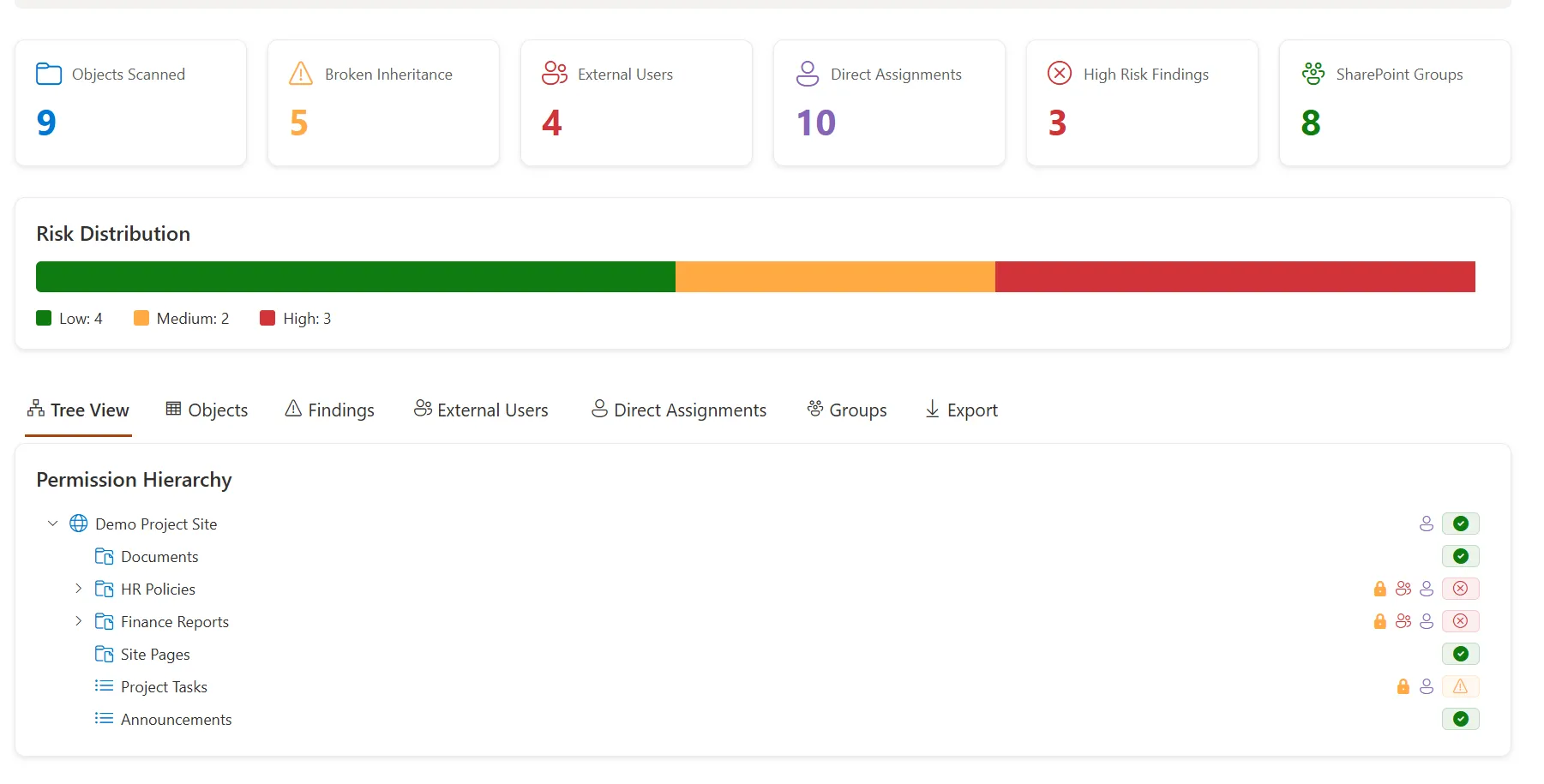
I also recently built a complementary open-source project: SPFx Permission Visualizer, which helps admins understand who has access, where permissions are broken, and which areas need review.
For SPFx development consulting, SharePoint governance, or architecture guidance, feel free to get in touch.
Need a production-ready SPFx solution?
I build SharePoint Framework web parts, extensions, dashboards, and integrations using React, TypeScript, PnPjs, and Microsoft Graph.
Free SharePoint planning resource
Solving the technical issue is only part of the Microsoft 365 problem.
Use the checklist to review the governance, permission, ownership, and support decisions that often determine whether a SharePoint solution succeeds long term.
Download the ChecklistBilly Peralta
SharePoint & Microsoft 365 Specialist • 16+ Years Experience
If you have questions about your SharePoint environment, feel free to reach out.
Need a production-ready SPFx solution?
I build SharePoint Framework web parts, extensions, dashboards, and integrations using React, TypeScript, PnPjs, and Microsoft Graph.